
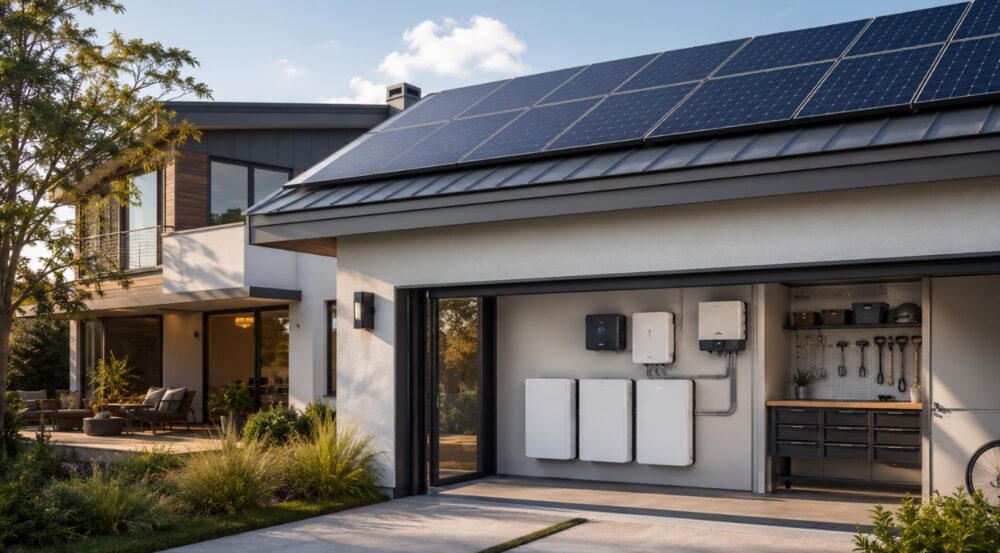
Solar backup power in 2026 is no longer a choice between a noisy generator and an expensive fixed battery. Homeowners can now choose from high-output whole-home batteries, modular storage that grows over time, and portable systems that can connect to selected household circuits.
The best option depends less on brand name than on three practical questions: what must stay powered, how long outages usually last, and whether the home already has rooftop solar.
This guide compares the strongest current approaches, explains the numbers that matter, and highlights one major 2026 change: the federal residential clean-energy tax credit is no longer available for new installations.
What solar backup power needs to do in 2026
A useful solar backup system has to do more than store energy. It needs enough inverter power to start motors, enough battery capacity to run priority loads through the night, and a safe way to isolate the home from the grid during an outage. For most households, that means pairing solar panels with an energy-storage system and automatic or manual transfer equipment.
Small rechargeable cells still have a place in an outage kit. A nimh rechargeable battery is practical for flashlights, radios, sensors, and other AA- or AAA-powered devices, but it is not a substitute for a home battery measured in kilowatt-hours.
The Department of Energy explains that solar plus storage lets homeowners save daytime solar generation for later use, including periods when the grid is down.
Whole-home batteries are best for broad automatic coverage
For homeowners who want automatic backup across most or all household circuits, integrated wall-mounted batteries remain the most straightforward route.
Tesla Powerwall 3 provides 13.5 kWh of energy capacity and up to 11.5 kW of continuous power, with an integrated solar inverter.
FranklinWH aPower 2 offers 15 kWh per unit and 10 kW of continuous output, with lithium iron phosphate chemistry.
| System | Energy capacity | Continuous output |
| Tesla Powerwall 3 | 13.5 kWh | 11.5 kW |
| FranklinWH aPower 2 | 15 kWh | 10 kW |
Those figures matter because capacity tells you how long the battery can run loads, while power tells you how many demanding appliances can operate at once. Air conditioning, well pumps, electric cooking, and other motor or resistance loads make output capability especially important.
Modular batteries make phased upgrades easier
Modular systems make more sense when homeowners want to start smaller and add storage later. Enphase’s IQ Battery 5P provides 5.0 kWh of usable energy and 3.84 kW of continuous power per unit, so installers can combine multiple batteries to match a home’s load profile. It is AC-coupled, which can be attractive for homes that already have solar and need storage added without replacing the entire solar array.
- Start with a smaller storage bank for refrigeration, lighting, internet, and outlets.
- Add more battery units if outage duration or household demand increases.
- Pair the batteries with the required Enphase system controller for backup operation.
The trade-off is that a modular design can involve more equipment and installation planning than a single large battery. In return, homeowners avoid buying maximum capacity before they know they need it.
Portable systems can cover essentials without a fixed battery wall
Portable home-energy systems now sit between camping power stations and permanently installed batteries.
EcoFlow’s DELTA Pro Ultra starts with 6 kWh of storage and 7.2 kW of output in a single U.S. unit, and the current platform can scale much higher with additional batteries and inverters. Used alone, it can power devices directly; paired with compatible transfer equipment or Smart Home Panel 2, it can support selected household circuits with automatic switching.
This approach is appealing for renters, smaller homes, workshops, and owners who want equipment that can be moved or expanded. It also reduces the commitment of installing a fixed battery wall on day one.
However, connecting any portable system to household wiring is not the same as plugging in an appliance. Service-panel, transfer-switch, and other permanent electrical connections should be handled by a qualified electrician.
Size backup around outage loads, not your monthly bill
The right battery size starts with an outage plan, not a monthly electric bill. First list the circuits that truly need backup, then check each appliance’s running watts and any startup surge shown on its label or manual. Multiply power by expected operating time to estimate energy use in watt-hours, then leave room for conversion losses, weather, and unexpected demand.
- Protect refrigeration, medical equipment, communications, and basic lighting first.
- Decide whether heating, cooling, a well pump, or cooking must remain available.
- Separate “must run” loads from appliances that can wait until grid power returns.
- Ask the installer how much solar can recharge the battery during an extended outage.
Reducing household demand can stretch every kilowatt-hour. Air sealing, insulation, HVAC maintenance, and other energy-efficiency improvements around the home lower the load that a backup system must carry.
The 2026 tax rules change the buying decision

The financial calculation changed sharply in 2026. The IRS says the Residential Clean Energy Credit is not available for expenditures made after December 31, 2025. That means homeowners shopping for a new solar battery this year should not assume the former 30% federal credit will reduce the project cost. State, local, and utility programs may still exist, but eligibility varies by location and program rules.
Price comparisons should include more than battery capacity. Ask for the installed cost, electrical upgrades, transfer equipment, permits, monitoring hardware, warranty terms, and any subscription or service fees. A cheaper battery can become the more expensive project if the electrical work is complex.
Treat backup power as part of the home budget rather than an impulse purchase. A written homeowner budgeting plan can help compare resilience benefits with other maintenance and efficiency priorities before signing a contract.
Frequently asked questions
1. Will rooftop solar keep working during a blackout?
Only if the system is designed for backup or islanded operation. Standard grid-tied solar normally shuts down when utility power fails, while compatible solar-plus-storage equipment can continue supplying protected loads.
2. Can a home battery be installed in a garage?
Often yes, but placement depends on the battery’s listing, manufacturer instructions, local fire code, temperature range, spacing, and protection from vehicle impact.
3. Can an electric vehicle replace a home battery?
Some EVs can provide backup power through bidirectional vehicle-to-home technology, but it requires a compatible vehicle, bidirectional charger, home integration equipment, and utility approval where required. It is not yet universal.
4. Should a battery stay fully charged all the time?
Not necessarily. Reserve settings and daily charge targets depend on the system, tariff, outage risk, and manufacturer guidance.
Which solar backup option makes sense in 2026?
For most modern homes, the strongest 2026 strategy is to match backup equipment to actual outage priorities. Tesla Powerwall 3 and FranklinWH aPower 2 suit households seeking high-output whole-home storage; Enphase IQ Battery 5P works well for modular expansion; and EcoFlow DELTA Pro Ultra offers a flexible bridge between portable and integrated backup.
The deciding factors should be usable energy, continuous and surge power, solar recharge capability, electrical compatibility, warranty, and local code requirements. With the federal residential clean-energy credit ended for new 2026 expenditures, careful system sizing and a complete installed-cost quote matter more than ever before purchase.